Rock Art at the Naval Air Weapons Station China Lake
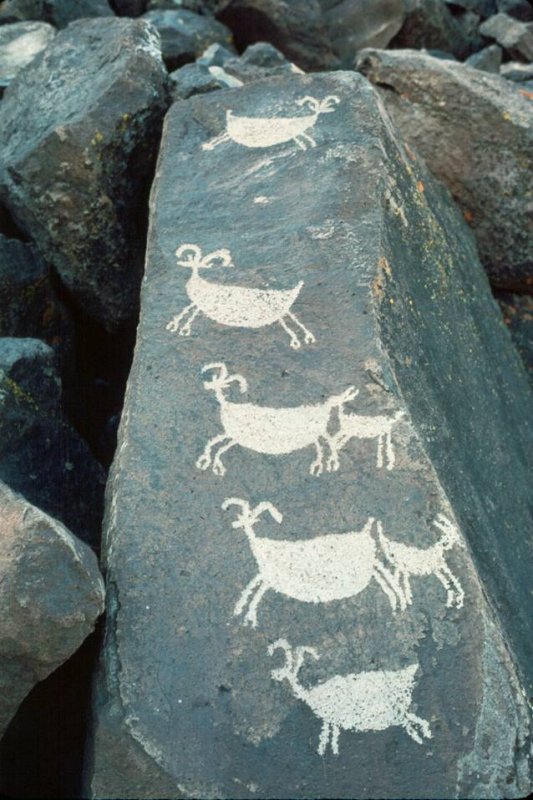 The Coso region, located within the Naval Air Weapons Station (NAWS) Communist china Lake, in the desert of interior southern California, is home to some of the nearly spectacular displays of Native American rock art anywhere on the continent.
 Distinctive, highly stylized images of bighorn sheep, shield-like images, and man-similar figures distinguish Coso rock art from that of surrounding regions. Most of these figures were fabricated past pecking, grinding, or scratching a design into a rock'southward surface. Researchers refer to these types of designs as petroglyphs, as distinct from painted ones (pictographs).
Most of the Coso petroglyphs appear to be 1000 to 3000 years one-time, though the practise of making rock fine art in this surface area may accept begun with the earliest occupation of the region (as early as xiii,500 years ago) and connected into historic times.
Here, you lot can see examples of this rock art at several recently discovered sites at NAWS China Lake, along with commentary on the rock art, every bit well as maps and other information about the sites.

RESPECT AND PROTECT
Rock art provides a window into the by rituals, beliefs, and artistic abilities of its creators. Because of its scientific, aesthetic, and religious significance, it deserves respectful behavior. This unique and aboriginal artwork is likewise very fragile. We can help ensure its preservation so that our grandchildren's grandchildren will also be able to capeesh it. Delight never touch or utilize any chalk or other fabric on the designs. Please avert walking or sitting on rock art panels. When visiting a stone art site, leave no trace of your trip then that others may have the pleasure of finding the site in its pristine, undisturbed condition. If you see vandalism or harm occurring on public land, please report it to an appropriate land steward.
WHAT DOES IT MEAN?
Rock art tin exist difficult for researchers to interpret. Many stone fine art traditions accept few or no living practitioners. In the absence of direct explanations provided by the artists, attempts to notice meaning in rock art can be highly speculative. Many dissimilar functions have been attributed to stone art. In some contexts, it may serve as illustrative fine art that teaches a lesson or commemorates a noteworthy upshot. In others, information technology may play a part in religious practices that seek supernatural influence or control over events. In yet other contexts, it may mark territorial boundaries, or help to keep runway of the passing of time by marking celestial events such as equinoxes or solstices.
Two major theories on the function of Coso rock art have been proposed. I theory connects it with so-chosen "hunting magic." Noting the immense number of sheep drawings in the Coso engravings, Campbell Grant and others hypothesized in the 1960s that the hunter-gatherers living in this area were heavily dependent on bighorn sheep for subsistence, and that the rock drawings were created as role of a ritual meant to ensure a successful hunt. The introduction of the bow and arrow 1500 years ago led to more efficient hunting of the sheep, and hence eventual depletion of their populations. As herds dwindled, the production of stone fine art -- particularly bighorn and anthropomorphic (human-like) designs -- intensified in attempt to restore the sheep. With the final collapse of the sheep population, the hunting magic was abased.
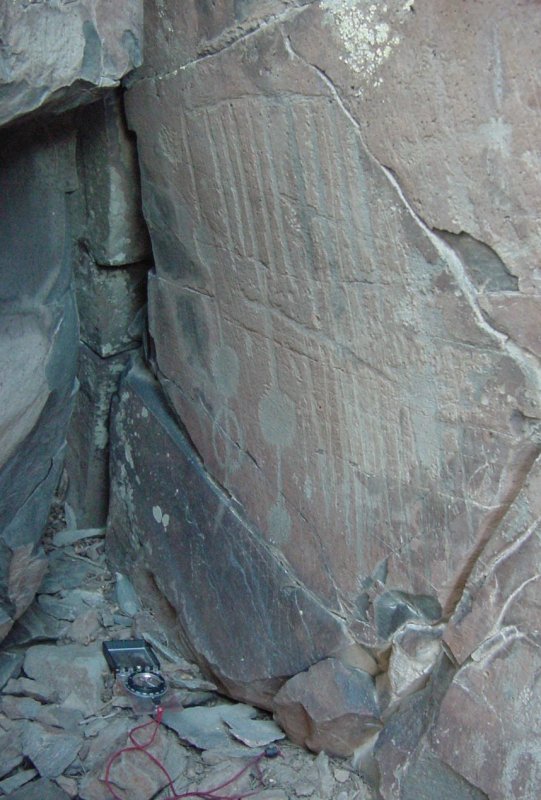 The other theory interprets Coso rock art as the work of shamans or medicine men who drew natural symbols (by and large abstract geometric images brought to the mind'south eye when in a trance), images of the animal spirit helper that assisted the shaman in obtaining supernatural ability, or images of the shaman's transformation into that spirit. Native American groups in the Great Basin commonly acquaintance pelting shamans with bighorn sheep. The prevalence of bighorn sheep in Coso stone art is interpreted as an indication that the area is especially vested with supernatural power capable of controlling weather condition. This theory has been developed primarily by David Whitley, who has practical this interpretive framework to a broad range of sites throughout the Great Basin.
Grant's theory suggests a chronological sequence in which abstract forms come up earliest, followed by the representational designs of the hunting ritual. Other rock art studies indicate that these representational designs were followed by simple, scratched designs. In dissimilarity, Whitley's theory would indicate that all of these different styles were produced more or less continuously. Thus, deciding betwixt these competing theories would be easy if Coso rock fine art could exist dated.
Unfortunately, this is a hard task. Petroglyphs cannot be directly dated like other archaeological finds, and archaeologists must rely on other lines of evidence. Superposition, that is the placement of one rock art chemical element over some other, indicates the relative age of those two elements. Observing many such superpositions may allow the researcher to determine that a particular style of rock art is older than another, but it does not fix the accented age of either. Also, different figures of a rock art panel may simply await more weathered than other elements, suggesting that they have been exposed to the elements for a longer fourth dimension. As with superposition, it takes a large number of these kinds of observations to prove trends through time in rock fine art styles.
Some other way of determining the historic period of rock art is to date nearby archaeological finds, such as the remains of dwellings, hearths, or flaked rock artifacts such as arrowheads. While information technology cannot be proved beyond whatsoever incertitude that the rock art and the nearby finds at a given archaeological site were actually produced at the same time, archaeologists can await at many such archaeological "associations" and discern trends that make the overall movie much more convincing than would any single archaeological site.
WHAT DOES IT LOOK Like?
Coso rock art is found throughout the forested uplands of the Coso Range, equally well as the broad castor-covered plateau to the south. Although these areas differ in many ways, they both have large outcrops of basalt that form extensive scarps or rimrocks on which the rock art is typically found. These outcrops have adult a nighttime brown-to-blackness patina or "desert varnish" that is hands pecked or scratched away to reveal the lighter rock beneath. Many dissimilar kinds of designs are found in Coso rock fine art. These include abstract patterns such as grids, nested and bifurcated circles, "shields," patterns of dots, and parallel and radiating lines. Representational figures make up some other full general type, and are usually sheep, human-like figures, deer, mountain lions or dogs, and rectangular "medicine bags" or purse-like figures. These types of designs were usually made by pecking at the rock with a hammerstone. Another, very different technique was to simply scratch the surface of the boulder. As discussed to a higher place, this uncomplicated three-part scheme of abstruse, representational, and scratched designs is thought by some researchers to reflect stylistic changes over time.
Here you can see the rock art at half dozen archaeological sites in the Coso region. Two ecology settings are represented: the Basalt Lowlands and the adjacent Pinyon Uplands.
Basalt Lowlands Sites
Pinyon Uplands Sites
WANT TO Learn More than?
There is public access to one canyon that contains an extraordinary concentration of Coso stone art, through tours arranged by NAWS China Lake's Public Diplomacy Function and by the Maturango Museum in Ridgecrest. To learn how to arrange a tour, email peggy.shoaf@navy.mil, or contact the Maturango Museum at (760)375-6900 (http://world wide web.maturango.org). Further Reading
Grant, Campbell, James Baird, and Ken Pringle (1968). Stone Drawings of the Coso Range, Inyo County, California. Maturango Museum Publication No. 12. Maturango Press, Ridgecrest, California.
Whitley, David South. (1996). A Guide to Stone Art Sites: Southern California and Southern Nevada. Mountain Printing Publishing Company, Missoula, Montana.
Whitley, David S. (2000). The Art of the Shaman: Stone Art of California. University of Utah Press, Salt Lake Urban center.
Younkin, Elva, ed. (1998). Coso Rock Art: A New Perspective. Maturango Museum Publication No. 12. Maturango Press, Ridgecrest, California.
www.farwestern.com
Amy J. Gilreath (writer and photographer), Jerome King (author) and Reinhard Pribish (graphic designer)
Source: https://farwestern.com/rockart/
0 Response to "Rock Art at the Naval Air Weapons Station China Lake"
Post a Comment