Are Movies Getting Good Reviews Just Because They Court Diversity
8.iii Movies and Civilisation
Learning Objectives
- Recognize how movies reverberate cultural attitudes, trends, and events.
- Indicate how movies influence culture.
Movies Mirror Civilisation
The human relationship betwixt movies and culture involves a complicated dynamic; while American movies certainly influence the mass culture that consumes them, they are also an integral part of that civilization, a production of information technology, and therefore a reflection of prevailing concerns, attitudes, and beliefs. In considering the human relationship between picture show and civilisation, it is important to go on in heed that, while sure ideologies may be prevalent in a given era, not only is American culture as diverse every bit the populations that class information technology, merely it is also constantly changing from one period to the side by side. Mainstream films produced in the belatedly 1940s and into the 1950s, for example, reflected the conservatism that dominated the sociopolitical arenas of the fourth dimension. Nevertheless, by the 1960s, a reactionary youth culture began to emerge in opposition to the dominant institutions, and these antiestablishment views before long found their way onto the screen—a far weep from the attitudes most usually represented only a few years earlier.
In one sense, movies could be characterized as America'south storytellers. Non simply do Hollywood films reflect sure usually held attitudes and behavior about what it means to be American, merely they also portray contemporary trends, issues, and events, serving equally records of the eras in which they were produced. Consider, for example, films almost the September eleven, 2001, terrorist attacks: Fahrenheit 9/11, Globe Merchandise Center, United 93, and others. These films grew out of a seminal event of the time, one that preoccupied the consciousness of Americans for years later on it occurred.
Nativity of a Nation
In 1915, director D. W. Griffith established his reputation with the highly successful film The Nascency of a Nation, based on Thomas Dixon's novel The Clansman, a prosegregation narrative about the American South during and after the Civil War. At the time, The Nascency of a Nation was the longest feature film always made, at nearly iii hours, and contained huge battle scenes that amazed and delighted audiences. Griffith's storytelling ability helped solidify the narrative way that would become on to dominate feature films. He also experimented with editing techniques such as close-ups, spring cuts, and parallel editing that helped make the moving-picture show an artistic achievement.
Griffith'southward film found success largely because information technology captured the social and cultural tensions of the era. As American studies specialist Lary May has argued, "[Griffith's] films dramatized every major concern of the twenty-four hours (May, 1997)." In the early 20th century, fears virtually recent waves of immigrants had led to certain racist attitudes in mass culture, with "scientific" theories of the fourth dimension purporting to link race with inborn traits like intelligence and other capabilities. Additionally, the dominant political climate, largely a reaction against populist labor movements, was one of bourgeois elitism, eager to aspect social inequalities to natural human differences (Darity). According to a report by the New York Evening Postal service after the film's release, even some Northern audiences "clapped when the masked riders took vengeance on Negroes (Higham)." Withal, the outrage many groups expressed about the film is a expert reminder that American civilization is not monolithic, that at that place are always strong contingents in opposition to ascendant ideologies.
While critics praised the picture show for its narrative complication and epic scope, many others were outraged and even started riots at several screenings because of its highly controversial, openly racist attitudes, which glorified the Ku Klux Klan and blamed Southern Blacks for the destruction of the war (Higham). Many Americans joined the National Association for the Advancement of Colored People (NAACP) in denouncing the film, and the National Lath of Review eventually cutting a number of the motion-picture show's racist sections (May). However, information technology's important to go along in mind the attitudes of the early 1900s. At the fourth dimension the nation was divided, and Jim Crow laws and segregation were enforced. Still, The Birth of a Nation was the highest grossing movie of its era. In 1992, the film was classified past the Library of Congress amidst the "culturally, historically, or aesthetically significant films" in U.South. history.
Figure 8.half dozen
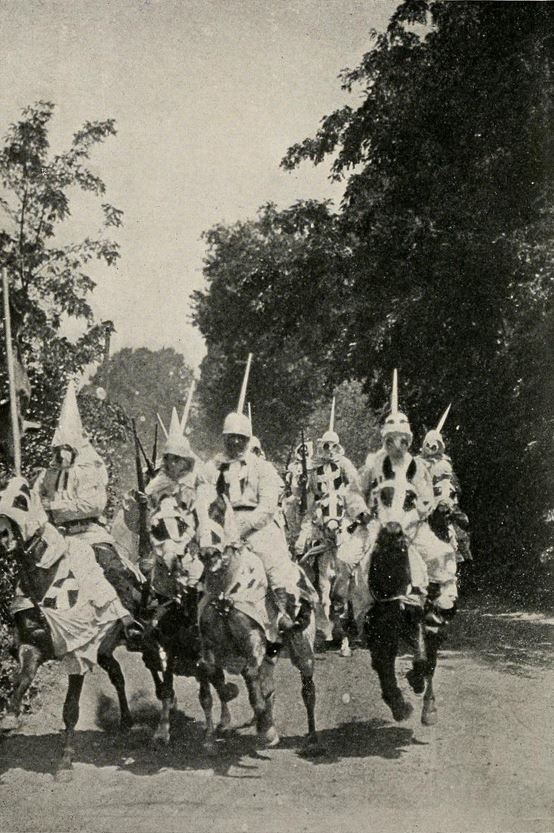
The Birth of a Nation expressed racial tensions of the early 20th century.
Wikimedia Commons – public domain.
"The American Style"
Until the bombing of Pearl Harbor in 1941, American films subsequently World War I generally reflected the neutral, isolationist opinion that prevailed in politics and culture. However, later the United States was drawn into the war in Europe, the authorities enlisted Hollywood to help with the war endeavor, opening the federal Bureau of Motion Movie Affairs in Los Angeles. Bureau officials served in an advisory capacity on the production of state of war-related films, an effort with which the studios cooperated. As a consequence, films tended toward the patriotic and were produced to inspire feelings of pride and confidence in beingness American and to clearly found that America and its allies were forces of good. For instance, critically acclaimed Casablanca paints a picture of the ill furnishings of fascism, illustrates the values that heroes similar Victor Laszlo agree, and depicts America equally a place for refugees to find democracy and freedom (Digital History).
These early on World War II films were sometimes overtly propagandist, intended to influence American attitudes rather than present a genuine reflection of American sentiments toward the war. Frank Capra's Why We Fight films, for example, the commencement of which was produced in 1942, were developed for the U.S. Army and were later shown to general audiences; they delivered a war message through narrative (Koppes & Black, 1987). As the war continued, however, filmmakers opted to forego patriotic themes for a more serious reflection of American sentiments, equally exemplified by films like Alfred Hitchcock's Lifeboat.
Youth versus Age: From Counterculture to Mass Culture
In Mike Nichols'due south 1967 film The Graduate, Dustin Hoffman, as the picture show's protagonist, enters into a romantic affair with the wife of his male parent's business partner. Still, Mrs. Robinson and the other adults in the motion picture fail to sympathize the young, alienated hero, who eventually rebels against them. The Graduate, which brought in more than $44 million at the box office, reflected the attitudes of many members of a young generation growing increasingly dissatisfied with what they perceived to be the repressive social codes established past their more than conservative elders (Dirks).
This baby boomer generation came of age during the Korean and Vietnam wars. Not only did the youth culture limited a pessimism toward the patriotic, prowar stance of their World War II–era elders, merely they displayed a fierce resistance toward institutional authorisation in general, an antiestablishmentism epitomized in the 1967 hit moving picture Bonnie and Clyde. In the film, a young, outlaw couple sets out on a cross-state banking concern-robbing spree until they're killed in a violent constabulary ambush at the film's close (Belton).
Figure 8.7
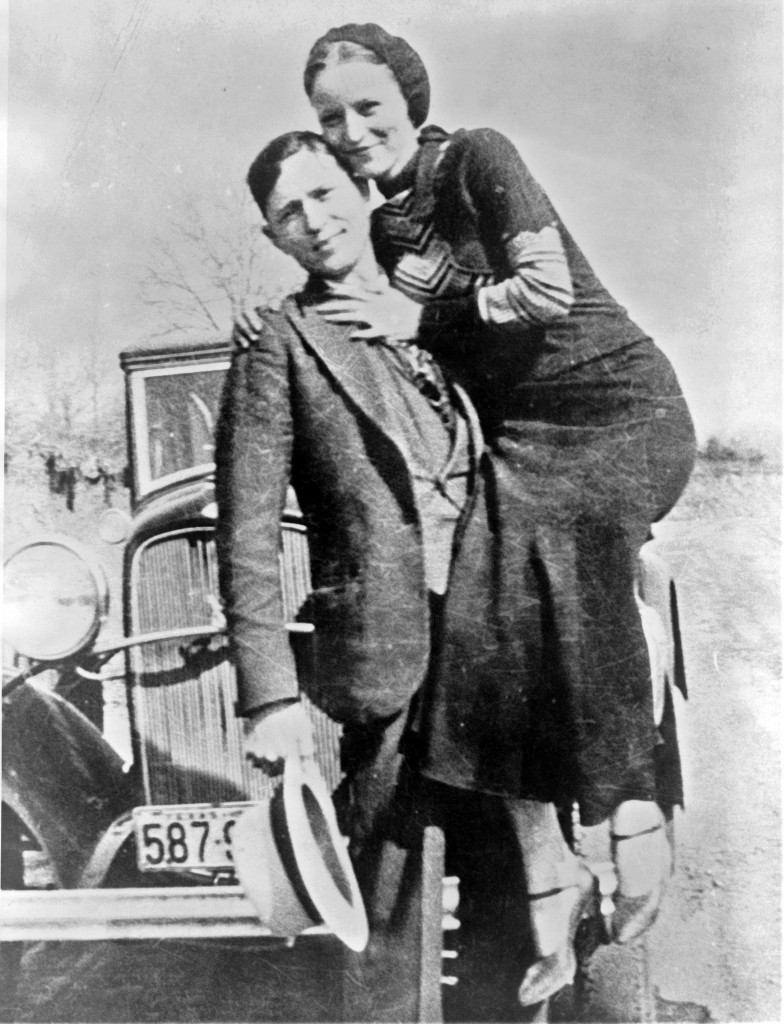
Bonnie and Clyde reflected the attitudes of a rising youth civilisation.
Wikimedia Eatables – public domain.
Bonnie and Clyde'south violence provides one case of the means films at the time were testing the limits of permissible on-screen material. The youth civilization's liberal attitudes toward formally taboo subjects like sexuality and drugs began to emerge in motion-picture show during the late 1960s. Like Bonnie and Clyde, Sam Peckinpah's 1969 Western The Wild Bunch, displays an early on instance of aestheticized violence in picture show. The wildly popular Easy Rider (1969)—containing drugs, sexual activity, and violence—may owe a good deal of its initial success to liberalized audiences. And in the same year, Midnight Cowboy, one of the first Hollywood films to receive an Ten rating (in this case for its sexual content), won three Academy Awards, including Best Picture (Belton). Every bit the release and subsequently successful reception of these films adjure, what at the decade's outset had been countercultural had, past the decade'southward close, become mainstream.
The Hollywood Product Lawmaking
When the MPAA (originally MPPDA) first banded together in 1922 to combat government censorship and to promote artistic freedom, the association attempted a system of cocky-regulation. Withal, by 1930—in part because of the transition to talking pictures—renewed criticism and calls for censorship from conservative groups made information technology articulate to the MPPDA that the loose system of cocky-regulation was not enough protection. As a effect, the MPPDA instituted the Production Code, or Hays Code (afterwards MPPDA director William H. Hays), which remained in place until 1967. The lawmaking, which according to motion picture producers concerned itself with ensuring that movies were "directly responsible for spiritual or moral progress, for higher types of social life, and for much correct thinking (History Matters)," was strictly enforced starting in 1934, putting an end to well-nigh public complaints. However, many people in Hollywood resented its restrictiveness. Afterward a series of Supreme Court cases in the 1950s regarding the code'south restrictions to freedom of spoken communication, the Product Lawmaking grew weaker until it was finally replaced in 1967 with the MPAA rating organisation (American Decades Primary Sources, 2004).
MPAA Ratings
As films like Bonnie and Clyde and Who's Afraid of Virginia Woolf? (1966) tested the limits on violence and language, it became clear that the Product Lawmaking was in need of replacement. In 1968, the MPAA adopted a ratings system to identify films in terms of potentially objectionable content. Past providing officially designated categories for films that would not have passed Production Lawmaking standards of the past, the MPAA opened a way for films to deal openly with mature content. The ratings organisation originally included four categories: Thou (suitable for full general audiences), Thousand (equivalent to the PG rating of today), R (restricted to adults over age xvi), and Ten (equivalent to today'due south NC-17).
The MPAA rating systems, with some modifications, is still in place today. Before release in theaters, films are submitted to the MPAA lath for a screening, during which advisers decide on the most appropriate rating based on the film's content. However, studios are not required to have the MPAA screen releases alee of time—some studios release films without the MPAA rating at all. Commercially, less restrictive ratings are more often than not more beneficial, particularly in the case of developed-themed films that have the potential to earn the virtually restrictive rating, the NC-17. Some picture show theaters will not screen a movie that is rated NC-17. When filmmakers get a more than restrictive rating than they were hoping for, they may resubmit the film for review after editing out objectionable scenes (Dick, 2006).
The New State of war Film: Cynicism and Feet
Unlike the patriotic war films of the World War II era, many of the films nearly U.S. involvement in Vietnam reflected potent antiwar sentiment, criticizing American political policy and portraying war's damaging furnishings on those who survived it. Films like Dr. Strangelove (1964), M*A*South*H (1970), The Deer Hunter (1978), and Apocalypse Now (1979) portray the military machine establishment in a negative low-cal and dissolve articulate-cut distinctions, such as the "us versus them" mentality, of earlier war films. These, and the dozens of Vietnam War films that were produced in the 1970s and 1980s—Oliver Stone'south Platoon (1986) and Born on the Fourth of July (1989) and Stanley Kubrick's Full Metallic Jacket (1987), for example—reverberate the sense of defeat and lack of closure Americans felt after the Vietnam War and the emotional and psychological scars it left on the nation's psyche (Dirks, 2010; Anderegg, 1991). A spate of armed forces and politically themed films emerged during the 1980s as America recovered from defeat in Vietnam, while at the aforementioned time facing anxieties about the ongoing Common cold War with the Soviet Union.
Fears most the possibility of nuclear war were very real during the 1980s, and some film critics contend that these anxieties were reflected not only in overtly political films of the time but also in the popularity of horror films, like Halloween and Friday the 13th, which characteristic a mysterious and unkillable monster, and in the popularity of the fantastic in films similar East.T.: The Actress-Terrestrial, Raiders of the Lost Ark, and Star Wars, which offer imaginative escapes (Woods, 1986).
Movies Shape Culture
Simply as movies reverberate the anxieties, behavior, and values of the cultures that produce them, they also assist to shape and solidify a culture'south beliefs. Sometimes the influence is picayune, as in the instance of fashion trends or figures of speech. Subsequently the release of Flashdance in 1983, for instance, torn T-shirts and leg warmers became hallmarks of the fashion of the 1980s (Pemberton-Sikes, 2006). Even so, sometimes the impact tin be profound, leading to social or political reform, or the shaping of ideologies.
Picture show and the Rise of Mass Culture
During the 1890s and upward until about 1920, American culture experienced a period of rapid industrialization. As people moved from farms to centers of industrial production, urban areas began to concur larger and larger concentrations of the population. At the same time, film and other methods of mass communication (advertising and radio) developed, whose messages concerning tastes, desires, community, speech, and beliefs spread from these population centers to outlying areas across the country. The upshot of early mass-advice media was to wear abroad regional differences and create a more than homogenized, standardized culture.
Motion picture played a key office in this development, as viewers began to imitate the speech communication, dress, and behavior of their mutual heroes on the silverish screen (Mintz, 2007). In 1911, the Vitagraph company began publishing The Movement Picture Magazine, America's first fan magazine. Originally conceived as a marketing tool to keep audiences interested in Vitagraph'due south pictures and major actors, The Motion Film Magazine helped create the concept of the film star in the American imagination. Fans became obsessed with the off-screen lives of their favorite celebrities, like Pearl White, Florence Lawrence, and Mary Pickford (Doyle, 2008).
American Myths and Traditions
American identity in mass society is built around sure normally held behavior, or myths almost shared experiences, and these American myths are oftentimes disseminated through or reinforced by film. One instance of a popular American myth, one that dates dorsum to the writings of Thomas Jefferson and other founders, is an accent on individualism—a celebration of the common man or woman as a hero or reformer. With the rise of mass culture, the myth of the individual became increasingly appealing because it provided people with a sense of autonomy and individuality in the face of an increasingly homogenized culture. The hero myth finds apotheosis in the Western, a film genre that was popular from the silent era through the 1960s, in which the lone cowboy, a seminomadic wanderer, makes his mode in a lawless, and often dangerous, frontier. An example is 1952's High Noon. From 1926 until 1967, Westerns accounted for near a quarter of all films produced. In other films, like Frank Capra's 1946 movie It's a Wonderful Life, the individual triumphs by standing up to injustice, reinforcing the belief that one person can brand a departure in the world (Belton). And in more than recent films, hero figures such equally Indiana Jones, Luke Skywalker (Star Wars), and Neo (The Matrix) accept continued to emphasize individualism.
Social Issues in Moving-picture show
As D. W. Griffith recognized near a century ago, film has enormous power as a medium to influence public opinion. Ever since Griffith'southward The Nascence of a Nation sparked strong public reactions in 1915, filmmakers have been producing movies that address social issues, sometimes subtly, and sometimes very directly. More recently, films like Hotel Rwanda (2004), about the 1994 Rwandan genocide, or The Kite Runner (2007), a story that takes place in the midst of a war-torn Afghanistan, have captured audience imaginations by telling stories that heighten social sensation about world events. And a number of documentary films directed at social issues have had a strong influence on cultural attitudes and have brought most meaning change.
In the 2000s, documentaries, particularly those of an activist nature, were met with greater involvement than ever before. Films like Super Size Me (2004), which documents the furnishings of excessive fast-food consumption and criticizes the fast-food industry for promoting unhealthy eating habits for turn a profit, and Food, Inc. (2009), which examines corporate farming practices and points to the negative impact these practices can take on human wellness and the environment, accept brought most of import changes in American food culture (Severson, 2009). Just six weeks after the release of Super Size Me, McDonald's took the supersize choice off its carte du jour and since 2004 has introduced a number of healthy food options in its restaurants (Sood, 2004). Other fast-food chains have made similar changes (Sood, 2004).
Other documentaries intended to influence cultural attitudes and inspire change include those made by manager Michael Moore. Moore's films present a liberal stance on social and political issues such as health intendance, globalization, and gun control. His 2002 film Bowling for Columbine, for example, addressed the Columbine High School shootings of 1999, presenting a disquisitional examination of American gun civilisation. While some critics have defendant Moore of producing propagandistic material under the label of documentary because of his films' stiff biases, his films have been popular with audiences, with four of his documentaries ranking among the highest grossing documentaries of all time. Fahrenheit 9/11 (2004), which criticized the second Bush administration and its involvement in the Republic of iraq War, earned $119 1000000 at the box role, making it the most successful documentary of all time (Dirks, 2006).
Key Takeaways
- As products of mass culture, movies reverberate cultural attitudes, trends, and concerns:
- D. W. Griffith's film The Birth of a Nation, presenting a racist perspective on the U.Due south. Civil War and its aftermath, reflected racist concerns of the era in which it was produced.
- During Globe War II, films reflected the patriotic, prowar sentiments of the time.
- In the 1960s and 1970s with the rise of an antiestablishment youth civilization, movies adopted more liberal stances toward sexuality and violence and displayed a pessimism toward established social structures.
- Afterwards the failure of the Vietnam War, films reflected a more than clashing mental attitude toward state of war.
- The MPAA rating system, established in 1968, gave filmmakers greater freedom in the content they were able to portray on screen.
- Movies shape cultural attitudes and customs, as audiences adopt the attitudes and styles of the characters they sentinel on screen. Filmmakers may employ their movies to influence cultural attitudes toward sure social issues, as in Fahrenheit 9/11 and Super Size Me.
Exercises
- Consider three films yous have watched in the last year. In what ways have these films reflected current concerns, trends, or attitudes? Of these movies, which do you think have the about potential to shape cultural attitudes or bring about social change? How exercise you retrieve these movies might bring about this change?
- Locate a film that has been remade and watch the original and remade versions. Besides the obvious changes in fashion and applied science, what other differences practise you find that reflect the cultural attitudes, trends, and events in which each flick was produced?
References
American Decades Primary Sources, "The Production Code of the Movement Picture Producers and Distributers of America, Inc.—1930–1934," American Decades Primary Sources, ed. Cynthia Rose (Detroit: Gale, 2004), vol. 4, 12–15.
Anderegg, Michael. introduction to Inventing Vietnam: The State of war in Movie and Television set, ed. Michael Anderegg (Philadelphia: Temple University Press, 1991), six–8.
Belton, American Cinema/American Civilisation, 286.
Belton, John. introduction to Movies and Mass Culture, ed. John Belton, 12.
Darity, William A."Birth of a Nation," Encyclopedia of the Social Sciences, 2nd ed., ed. William A. Darity, Jr., Gale Virtual Reference Library, 1:305–306.
Dick, Kirby. interview by Terry Gross, Fresh Air, NPR, September 13, 2006, http://world wide web.npr.org/templates/story/story.php?storyId=6068009.
Digital History, Review of Casablanca, directed by Michael Curtiz, Digital History, http://www.digitalhistory.uh.edu/historyonline/bureau_casablanca.cfm.
Dirks, Tim. "1980s Motion picture History," Filmsite, 2010, http://www.filmsite.org.
Dirks, Tim. "Film History of the 2000s," Filmsite; Washington Postal service, "The 10 Highest-Grossing Documentaries," July 31, 2006, http://www.washingtonpost.com/wp-dyn/content/graphic/2006/07/31/GR2006073100027.html.
Dirks, Tim. review of The Graduate, directed by Mike Nichols, Filmsite, http://www.filmsite.org/grad.html.
Doyle, Jack. "A Star is Born: 1910s," Pop History Dig, 2008, http://www.pophistorydig.com/?tag=film-stars-mass-culture.
Higham, Art of the American Picture show, xiii.
History Matters, "Complete Nudity is Never Permitted: The Motion Motion-picture show Lawmaking of 1930," http://historymatters.gmu.edu/d/5099/.
Koppes, Clayton R. and Gregory D. Black, Hollywood Goes to War: How Politics, Profits and Propaganda Shaped Earth War II Movies (Los Angeles: The Gratis Press, 1987), 122.
May, "Apocalyptic Cinema," 46.
May, Lary. "Apocalyptic Cinema: D. W. Griffith and the Aesthetics of Reform," in Movies and Mass Civilisation, ed. John Belton (New Brunswick, NJ: Rutgers University Press, 1997), 26.
Mintz, Steven. "The Formation of Mod American Mass Culture," Digital History, 2007, http://www.digitalhistory.uh.edu/database/article_display.cfm?HHID=455.
Pemberton-Sikes, Diana. "15 Movies That Inspired Fashion Trends," The Wearable Chronicles, March 3, 2006, http://www.theclothingchronicles.com/archives/217-03032006.htm.
Severson, Kim. "Eat, Drink, Think, Change," New York Times, June 3, 2009, http://www.nytimes.com/2009/06/07/movies/07seve.html.
Sood, Suemedha. "Weighing the Touch of 'Super Size Me,'" Wiretap, June 29, 2004. http://www.wiretapmag.org/stories/19059/.
Wood, Robin. Hollywood from Vietnam to Reagan (New York: Columbia University Press, 1986), 168.
Source: https://open.lib.umn.edu/mediaandculture/chapter/8-3-movies-and-culture/
0 Response to "Are Movies Getting Good Reviews Just Because They Court Diversity"
Post a Comment